
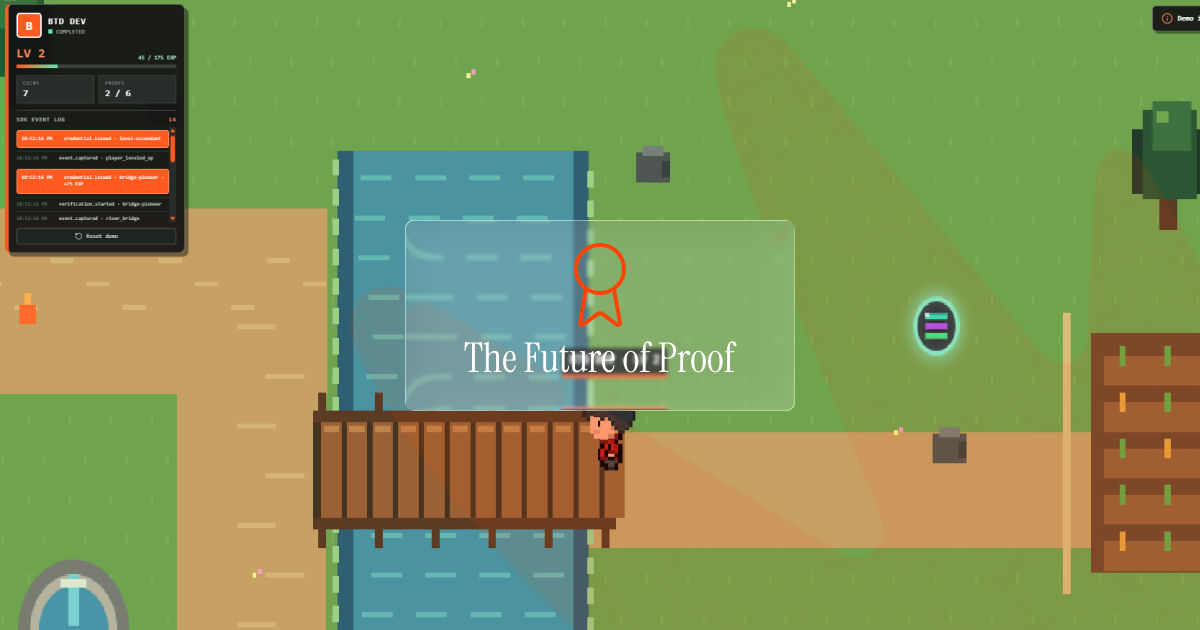
The Future of Proof: When Digital Actions Become Verifiable
The internet has spent decades proving who we are and what we own.
Accounts prove identity. Wallets prove control of assets. Blockchains prove transactions. Digital signatures prove that information came from a particular key.
But there's another question that becomes increasingly important as digital worlds grow:
How do we prove what we actually did?
In games, millions of meaningful actions happen every day. Players defeat difficult bosses, complete challenges, discover hidden worlds, reach competitive ranks, help teammates, set records, and spend years building reputations.
Most of those accomplishments exist only inside the system where they happened.
The future of proof could change that.
Not by putting everything onchain.
Not by turning every action into a token.
But by creating infrastructure that can transform meaningful digital actions into verifiable evidence.
Proof is moving from ownership to action
Web3 introduced a powerful primitive:
Wallet↓Asset↓Cryptographic ownership
Anyone can independently verify that a wallet controls an asset.
But ownership only describes part of a person's digital history.
Consider two players who own the same game item.
One purchased it.
The other earned it after completing one of the hardest challenges in the game.
The asset may look identical.
The story behind it isn't.
Proof of Play introduces another primitive:
PLAYER↓ACTION↓EVIDENCE↓VERIFICATION↓PROOF
Instead of asking only "What does this wallet own?", systems can begin asking:
"What has this player actually accomplished?"
That's a much larger design space.
Games are already producing the evidence
The interesting thing is that games don't need to invent this data.
It already exists.
Every modern game continuously generates events:
enemy_defeatedquest_completedmatch_wonrank_reacheditem_discoveredcheckpoint_reachedplayer_reviveddungeon_completed
Those events power progression systems, analytics, achievements, matchmaking, quests, and countless internal mechanics.
The opportunity is to make selected events useful beyond their original purpose.
Not every event.
Only the deeds that matter.
A developer might decide that this combination:
Boss defeated+Heroic difficulty+No player deaths+Under 20 minutes
represents something meaningful.
The result becomes:
VERIFIED↓"Flawless Guardian"
The achievement isn't simply awarded because a database says true.
There is evidence behind the claim.
Proof should have layers
There probably won't be one universal definition of "proof."
Different accomplishments require different levels of trust.
A casual achievement might be fine with local evidence.
A competitive rank might require an authoritative game server.
A tournament result could require multiple trusted sources.
An achievement carrying economic value might require stronger anti-cheat and verification infrastructure.
The architecture could look like:
GAMEPLAY│▼EVIDENCE│┌─────────┼─────────┐▼ ▼ ▼LOCAL SERVER EXTERNALSIGNALS TELEMETRY SIGNALS└─────────┼─────────┘▼VERIFICATION│▼PROOF
The future isn't simply about generating more proofs.
It's about understanding how strong each proof actually is.
AI can understand the gray areas
Some deeds are easy to verify.
score >= 50,000
doesn't need intelligence.
Neither does:
boss == "ancient_dragon"ANDcritical == true
But games are full of accomplishments that are difficult to describe with a handful of conditions.
Imagine trying to verify:
"The player saved their entire squad through an exceptional defensive play."
Several things may have happened:
Boss begins lethal attack↓Player draws aggro↓Player activates shield↓Teammates reposition↓Player revives downed teammate↓Squad survives encounter
A deterministic system can understand individual events.
An intelligent system can potentially help interpret their relationship and context.
This is where AI becomes interesting for Proof of Play.
Not as an all-powerful judge.
As another verification tool.
The stronger model is:
Deterministic rules ──┐├──→ VERIFICATIONContextual AI ────────┘
Use rules when something can be objectively calculated.
Use intelligence when something genuinely requires interpretation.
Proof doesn't need to expose everything
If proof becomes portable, privacy becomes even more important.
A player shouldn't need to publish their entire gameplay history just to prove one accomplishment.
Suppose a player wants to prove:
Completed Dungeon X under 15 minutes.
The system doesn't necessarily need to expose every movement, attack, item, teammate interaction, or timestamp publicly.
Instead:
PRIVATEGameplay evidence↓Verification↓Canonicalization↓Cryptographic digestPUBLIC / PORTABLEAchievementIssuerVerification metadataDigest
Proof should reveal what needs to be proven, not everything that happened along the way.
This is particularly important if Proof of Play eventually becomes part of broader player identity.
A player's history could become portable
Today, switching games often means starting your identity from zero.
You might have:
3,000 hours in Game ATop 1% rank in Game BRare achievement in Game CTournament win in Game D
But Game E knows nothing about any of it.
Portable proof creates another possibility.
GAME A ──→ Proof ──┐GAME B ──→ Proof ──┤GAME C ──→ Proof ──┼──→ PLAYERGAME D ──→ Proof ──┘
The player becomes the connection between worlds.
This doesn't mean Game E should automatically trust every achievement from every game.
Each game can decide:
Who issued this?What was verified?How was it verified?Do we recognize this issuer?Does this proof matter here?
Portability isn't universal trust.
It's the ability to evaluate a claim without requiring it to remain trapped inside its original application.
Games could recognize deeds from other worlds
This becomes particularly interesting for developers.
Imagine an indie RPG deciding:
Players who can prove they completed a difficult challenge in one of our partner games receive access to a hidden quest.
Or a competitive platform recognizing verified tournament history.
Or a game community granting roles based on accomplishments rather than simply wallet holdings.
GAME A"Defeat The Guardian"↓PROOF↓PLAYER↓GAME B recognizes proof↓Secret quest unlocked
The games remain independent.
Their economies remain independent.
Their progression systems remain independent.
Proof becomes the bridge.
Reputation becomes something you earn
This idea extends beyond achievements.
Most online reputation today is platform-specific.
Your history on one platform rarely means anything somewhere else.
Proof-based systems could create reputation from verifiable actions instead.
For gaming, that could eventually include signals such as:
Competitive historyTournament participationCommunity achievementsCreator contributionsCompleted challengesTeam accomplishmentsLong-term progression
Rather than saying:
"Trust me, I'm an experienced player."
a player could selectively present evidence.
That doesn't require reducing someone to a universal reputation score.
In fact, avoiding one global score may be healthier.
Different communities can decide which deeds matter to them.
Web3 becomes more useful when it's less visible
This is also where blockchain infrastructure can find a more natural role in games.
Players don't need a transaction after every sword swing.
They don't need every movement stored publicly.
And a wallet doesn't need to become the game's primary interface.
Instead:
PLAY↓CAPTURE↓VERIFY↓PROVE↓OPTIONAL ONCHAIN ANCHOR
Web3 sits underneath the experience.
The player experiences the game.
Developers use blockchain only where portability, public verification, or ownership actually provides value.
The best infrastructure often becomes invisible.
Proof could extend beyond games
Games provide a particularly good environment for exploring this model because they already have structured events, rules, achievements, identities, and progression.
But the underlying concept is broader.
Digital systems increasingly contain actions that matter:
CREATEDCONTRIBUTEDCOMPLETEDPARTICIPATEDDISCOVEREDACHIEVEDHELPEDBUILT
Today, platforms usually ask users to trust their databases.
Tomorrow, some of those actions could produce portable evidence.
The interesting primitive isn't necessarily Proof of Play itself.
It may eventually become something broader:
Proof of Action.
A way to establish that a meaningful digital deed occurred according to a defined set of rules and evidence.
The challenge is trust
None of this works if the evidence itself is meaningless.
A blockchain cannot magically determine whether a player actually defeated a boss.
AI cannot magically know whether a modified game client fabricated an event.
Cryptographic hashing cannot turn false telemetry into truth.
The chain of trust still matters:
PLAYER ACTION↓TRUSTED OBSERVATION↓VALIDATED EVIDENCE↓DEFINED RULE↓VERIFICATION↓CREDENTIAL↓OPTIONAL PUBLIC PROOF
Every layer answers a different question.
That distinction will become increasingly important as digital proofs become more valuable.
The future of proof isn't about pretending everything can be trustless.
It's about making where the trust comes from explicit and verifiable.
From assets to deeds
The first era of Web3 focused heavily on digital assets.
What do you own?
Which wallet owns it?
Where did it move?
Those questions remain useful.
But digital identity contains much more than ownership.
A player isn't only their inventory.
They're also everything they've accomplished.
WHAT YOU OWN+WHAT YOU DID↓A richer digital identity
That second part is where Proof of Play becomes interesting.
The future we're building toward
At Btd Works, we see a future where games remain independent worlds but meaningful accomplishments don't necessarily have to disappear at their borders.
Developers define what matters.
Games generate the evidence.
Verification establishes whether the deed happened according to those rules.
AI can help understand complex context.
Cryptography can protect integrity.
Web3 can provide an optional portable settlement and anchoring layer.
And players can carry selected pieces of their history forward.
Not every click needs proof.
Not every achievement needs a credential.
Not every credential needs a blockchain.
But when an action genuinely matters, we believe there should be infrastructure capable of answering:
Can you prove it?
That's the future behind By The Deed.
From proof of ownership to Proof of Play.
From what you have to what you've done.
Play → Capture → Verify → Prove → Own.
Your actions are your proof.